139
Example 3: Convert 7 kilolitres into
a. hectolitres. b. litres. c. millilitres.
a. 7 k = 7 × 10 h = 70 h b. 7 k = 7 × 10 × 10 × 10 = 7,000
c. 7 k = 7 × 10 × 10 × 10 × 10 × 10 × 10 m = 70,00,000 m
Fill in the blanks.
a. 5,623 m = dm = cm = mm
b. 8.65 km = dam = m = cm
Convert 45,006 kg to the following units. Write the answers in your notebook.
a. decagrams b. grams c. centigrams d. milligram
Convert 7.8625 kilolitres to the following units. Write the answers in your notebook.
a. litres b. decalitres c. hectolitres d. millilitres
A basket of oranges weighs 2.6 kg. How much is that in grams?
A bucket can hold 15 litres of water. How many millilitres is that?
Smaller units into larger units
To convert a smaller unit into a larger unit, we move towards the right. So, at each step, we divide by 10.
Example 4: Convert 5 millimetres into
a. centimetre s. b. decimetres. c. metres.
a. 5 mm = cm = 0.5 cm
b. 5 mm = dm = dm = 0.05 dm

c. 5 mm = m = m = 0.005 m

Example 5: Convert 7 grams into
a. decagrams. b. hectograms. c. kilograms.
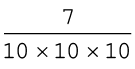
a. 7 g = dag = 0.7 dag
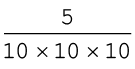
b. 7 g = hg = hg = 0.07 hg

c. 7 g = kg = kg = 0.007 kg

1
3
5


2


4
÷10
÷10
÷10
÷10
÷10
÷10
kilo
hecto
deca
metre/
gram/ litre
deci
centi
milli
1. Which is the bigger unit of length – metre or kilometre?
2. What operation would you perform if you have to convert a bigger unit to a smaller unit?
Understanding
better
Division of a number by 10, 100 or 1000 can be performed by moving the decimal point to the left by as many places as the number of zeros in the divisor.
Processing
better
v1.3-op